Wealth Matters: Charitable Giving Strategies
We give to charity to support a cause, to help a community we care about, to ensure a better future, or to solve a crisis. Fortunately, those gifts also come with a powerful side effect: a tax benefit. Thanks, Uncle Sam!
As you would expect, though, there are strict rules around the tax breaks you receive—and the rules just changed.
Thanks to recent tax updates under the One Big Beautiful Bill Act (OBBBA), anyone who itemizes deductions now faces a 0.5% of AGI hurdle before they can claim a penny of their charitable contributions. In other words, only the portion of your gifts above 0.5% of your AGI will be deductible.
Let's look at the real-world math:
Imagine your Adjusted Gross Income (AGI) is $250,000, and you give $3,000 a year to a charity you love. Because of the new floor, your first $1,250 is completely wiped out from a tax perspective.
Your Total Gift: $3,000
The OBBBA Hurdle: $1,250 (not deductible)
Your Actual Deduction: $1,750
While 0.5% sounds like a tiny percentage, it just slashed your tax deduction by over 40%! (This all assumes you’re itemizing. If your total deductions don’t clear the standard deduction, we’d first look at whether bunching helps you cross that line.)
So, what do we do about it? Charitable Bunching.
Charitable bunching simply means concentrating several years’ worth of donations into a single tax year. By doing this, you only have to clear that $1,250 hurdle once instead of clearing it every single year.
Look at how the numbers shake out when we bunch 4 years of giving into one:
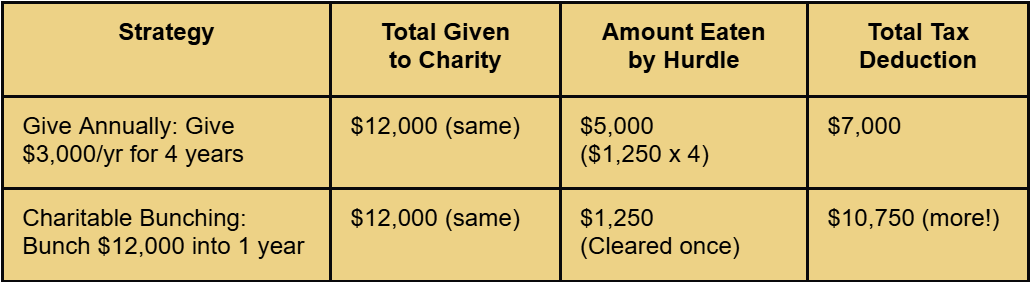
The benefit to your charity is exactly the same ($12,000). But your tax deduction just jumped by 53%.
But how do you actually execute this? You can't exactly hand a charity a massive check today and tell them you're "paid up" for the next four years. Instead, we use a tool called a Donor Advised Fund (DAF).
Think of a DAF as a personal holding account for your future charitable giving. It works in four simple steps:
Open the Account: You open a DAF account with a sponsoring organization, which holds the funds securely at a major custodian like Schwab or Fidelity.
Fund the DAF: You contribute your bunched amount to the DAF. The moment the money lands in the DAF, you get the full tax deduction for that year, because the DAF sponsor is itself a qualified charity. (Bonus tip: ideally, we fund this with highly appreciated stock to wipe out capital gains tax, but that's a topic for another day.)
Invest and Grow: The money doesn't have to leave the DAF immediately. It can sit in the account, invested tax-free, and continue to grow while you take your time selecting the causes you want to support over the next few years.
Distribute Over Time: You recommend grants out of the DAF to your favorite charities on your own schedule—mimicking your normal, steady giving habits.
You aren't trying to change your generosity. You are simply choosing to take the tax deduction on your terms. We can supercharge charitable bunching by pairing it with some other advanced strategies to use the tax deduction to its greatest advantage.
As an added bonus, many of my clients use a DAF as a family project, sitting down with their kids or grandkids to choose charities together and pass down the habit of giving.
If you are already supporting organizations you care about, it only makes sense to maximize the impact of your dollars. Supporting your favorite causes is important, but making sure you protect your hard-earned wealth matters, too.
If you want to see whether bunching and a DAF make sense for you this year, let’s model it out together.