Wealth Matter: When Should You Turn On Social Security?
Please keep in mind that Social Security benefits are a deep, complex topic. This article is meant to provide a framework for the major considerations, not a personalized claiming recommendation.
When it comes to Social Security, most retirees land in one of two camps:
Turn it on as soon as possible at age 62.
Delay it as long as possible, usually until age 70.
In reality, the best answer depends on your situation and may fall anywhere between 62 and 70.
To figure out where you land, we need to look at a few important considerations, sometimes complementary, sometimes competing:
Income and Work: Do you need the cash flow, and are you still working?
Retirement Spending: How will you actually spend money during retirement?
Health and Longevity: How long might you need the income?
Family and Survivor Needs: What happens to the surviving spouse?
Taxes and Retirement Planning: How does claiming affect your Golden Window?
Let’s walk through the major levers.
1. Are You Still Working?
If you claim Social Security before your Full Retirement Age and continue working, the Retirement Earnings Test may apply.
For someone under Full Retirement Age for all of 2026, Social Security withholds $1 of benefits for every $2 earned above $24,480. Once you reach Full Retirement Age, there is no earnings limit.
Let’s say you are earning $36,000 from work:
Annual earnings: $36,000
2026 earnings limit: $24,480
Earnings above the limit: $11,520
Benefits withheld: Approximately $5,760
Those benefits are not necessarily lost forever. Social Security generally recalculates your benefit at Full Retirement Age to account for months when benefits were withheld. But claiming early while continuing to earn a meaningful income may not be the most efficient strategy.
2. The Retirement Smile
Most financial plans assume your spending increases steadily throughout retirement. Real life usually looks a little different:
Go-Go Years: Spending starts higher as you travel, pursue hobbies, and enjoy your new freedom.
Slow-Go Years: Spending begins to settle as your lifestyle becomes more routine.
No-Go Years: Lifestyle spending may decrease, while healthcare and long-term care costs can increase.
We call this The Retirement Smile.
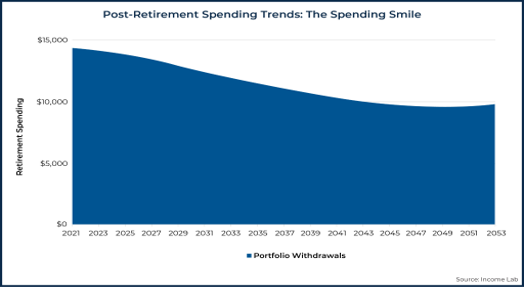
Because spending is often highest early in retirement, claiming Social Security earlier can help fund those years without drawing as heavily from investment accounts.
But that decision has to be weighed against the value of a larger guaranteed benefit later.
3. Health and Life Expectancy
Important reminder, delaying Social Security does not necessarily mean delaying Medicare. If you are not covered by qualifying employer insurance, you generally need to begin Medicare enrollment around age 65.
Social Security is a form of longevity insurance.
If your health or family history suggests a shorter life expectancy, claiming earlier might make sense. If you expect to live well into your 80s or beyond, delaying can provide a larger monthly benefit for more years.
A simple break-even analysis often lands somewhere around age 77 to 82.
The question is not simply, “Which option gives me the most total dollars?”
It is also: “Which option gives me the most useful income during the years I am likely to need it?” (Think back to The Retirement Smile.)
Here you can see that the cumulative benefit received when starting at 62 is the greatest through approximately age 77 (when compared to starting at 67), and through approximately age 79 (when compared to starting at 70).
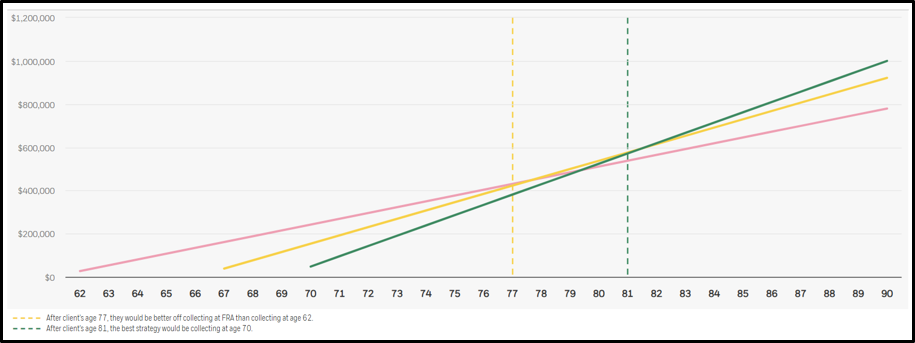
These break-even ages are illustrations, not universal rules. Actual results depend on the claiming ages being compared, COLAs, taxes, investment returns, and whether survivor benefits are included.
4. Family and Survivor Benefits
For married couples, Social Security is not an isolated decision.
When one spouse dies, the survivor generally receives the higher of their own benefit or the survivor benefit available from the deceased spouse’s record. They do not continue receiving both full benefits.
That makes the higher earner’s claiming decision especially important.
For example, assume:
Ed’s Primary Insurance Amount: $3,200 per month
Tina’s Primary Insurance Amount: $1,800 per month
If Ed delays from age 67 to age 70, his benefit can increase through delayed retirement credits. Social Security states that benefits are higher when delayed until age 70, with no additional increase for delaying beyond 70.
That larger benefit may provide a much stronger income floor for Tina if Ed passes away first.
5. Protecting Your “Golden Window”
The time between when you retire and the age when Required Minimum Distributions (RMDs) begin is what I call your Golden Window. For people born in 1960 or later, that age is generally 75.
This window of time is golden because we have more control over where we draw income from, thus controlling our tax exposure. This is a period of unusually high tax flexibility. You may be able to draw from traditional retirement accounts, complete Roth conversions, or harvest capital gains while managing your tax brackets intentionally.
Starting Social Security is one of the levers we can pull, but it can reduce that flexibility because it adds taxable income to the plan. Depending on your total income, up to 85% of Social Security benefits may be taxable.
That does not mean delaying is always correct. It means Social Security should be coordinated with the rest of your income plan, not treated as a separate decision.
Putting It Together: Ed and Tina
Ed is 64 and recently retired. Tina is 62 and working part-time as a physiotherapist, earning $36,000 per year.
Assume both have a Full Retirement Age of 67:
Ed’s Full Retirement Age benefit: $3,200 per month
Tina’s Full Retirement Age benefit: $1,800 per month
If they both claim immediately, they may:
Trigger the Retirement Earnings Test on Tina’s benefits.
Permanently reduce both of their monthly benefits.
Reduce the future survivor benefit available to Tina.
Add taxable income during years when they may otherwise have greater tax flexibility.
A more thoughtful plan might involve delaying Tina’s benefit while she continues working, delaying Ed’s benefit to strengthen the survivor income floor, and using their investment accounts during the early years of retirement.
That is not automatically the right answer. It is simply a better analysis than “claim at 62” or “always wait until 70.”
The right Social Security decision depends on your work status, health, family situation, spending needs, account types, tax brackets, and desire for guaranteed income.
If you are within a few years of retirement, let’s map out how Social Security fits with your broader income and tax strategy. That is how we make sure your wealth matters for the long haul.